Heat exchanger
made of porous aluminum
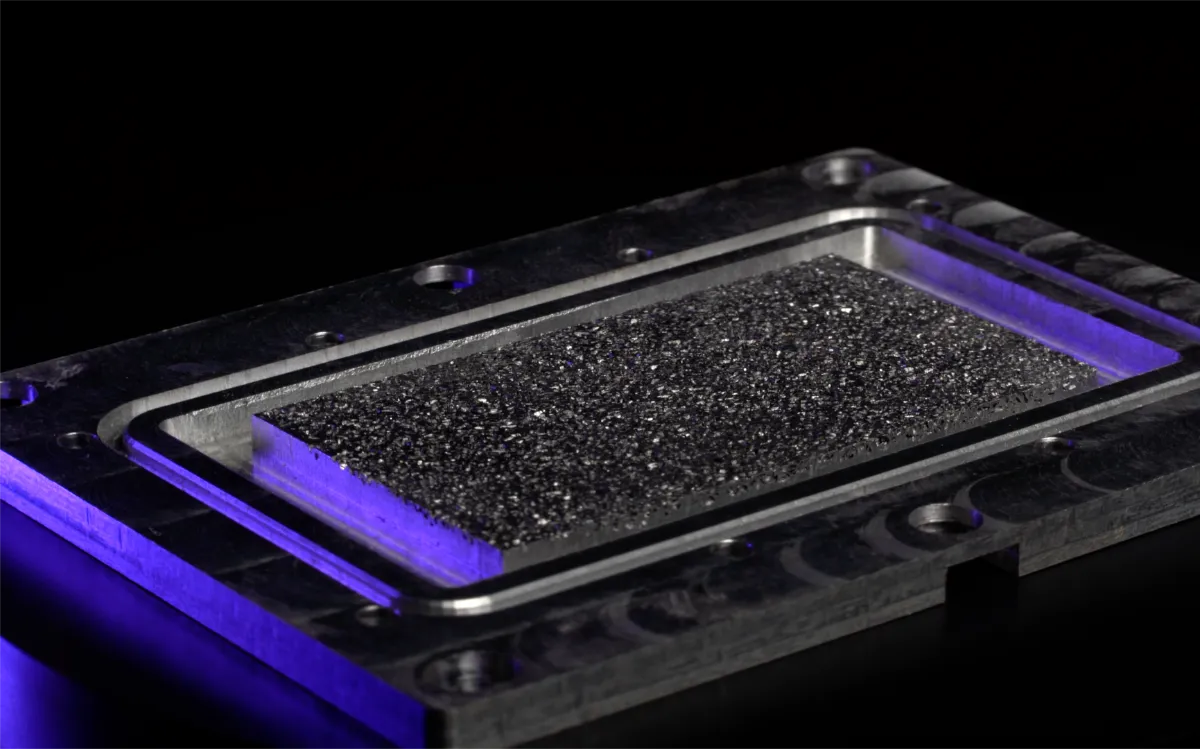
The feasibility of using porous aluminum in heat exchangers (e.g., radiators) is due to the combination of its characteristics, such as thermal conductivity and heat transfer. Our technology allows us to produce radiators consisting of a solid aluminum part and a porous part. The solid aluminum part serves for maximum heat removal due to the higher thermal conductivity of aluminum (203 W/m*K for Al vs. 50 W/m*K for porous Al), and the porous part, due to a significant increase in surface area, has a higher heat transfer, which means that the efficiency of the radiator increases.
In the case of cooling, the efficiency can be further improved by cooling the porous part with liquid, which accumulates in the pores and subsequently evaporates (illustrated in the photo). An additional advantage is the possibility of using different pore sizes, which allows for changes in the characteristics of the heat sinks.
In general, the use of porous aluminum in the production of heat exchangers gives such advantages as more efficient heat transfer, compact size, and light weight, which is especially important in industries such as aerospace, automotive, computer, and household appliances.