Space Technology
What does it take to increase payload weight while keeping costs down?
Aerospace
Honeycomb structures are widely used in critical components of aircraft of all classes, including various types of rockets and spacecraft.
Honeycomb structures also have a number of specific properties: long-term acoustic resistance, increased thermal conductivity, increased sound insulation ability and many other unique properties.
Cellular structures in aircraft construction.
Honeycomb panels are used in aircraft construction for the external cladding of the walls of load-bearing elements and floors. Often elements of small thickness are completely filled with honeycombs: rudders, ailerons, horizontal tail stabilizers.
Honeycomb structures in rocket and space engineering.
For a spacecraft, an important characteristic is its mass, since the larger it is, the more expensive it will be to launch it into a working orbit.
In rocket and space technology, three areas of use of honeycomb structures can be distinguished:
• structural purposes (missile fairings, transition compartments, garrots, antenna fairings, cruise missile control elements);
• heat-protective and heat-insulating purposes (aerodynamic screens, frontal shields, descent vehicles, etc.);
• structures that operate for a long time in outer space conditions (antennas, panels of unpressurized spacecraft, solar panels, size-stable platforms, etc.)
The use of porous aluminum products, when used as thermal insulation for hypersonic aircraft, significantly reduces their weight.
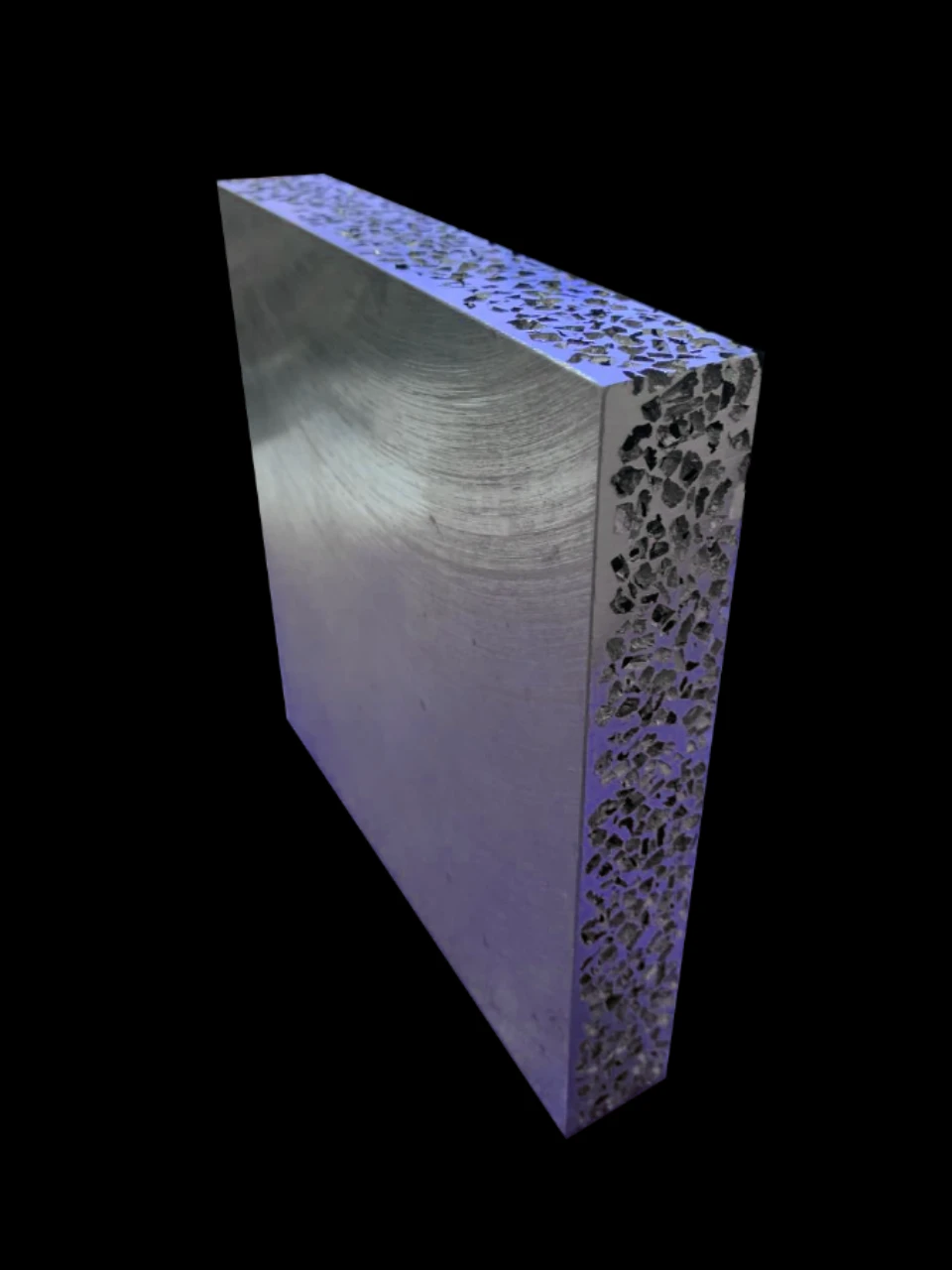
One of the ways to reduce the mass of spacecraft is to manufacture the platform’s load-bearing structure using COOL ALUM honeycomb panels. The novelty of the COOL ALUM solution will reduce the weight of the platform by 30-40% compared to the existing analogue.
The use of products made of porous aluminum with large pores for the production of honeycomb structures can significantly simplify the technological process of manufacturing honeycomb structures and reduce production costs.
The use of COOL ALUM products will provide:
• reduction in weight of the structure
• increase in specific static strength by 20–30%
• stability under longitudinal compression is 2–4 times higher
• thermal insulation properties are 3–5 times higher
• acoustic characteristics are 3–5 times better